I’ve spent years studying why some MVPs take off while others flop—despite having similar features, markets, and even funding.
The difference?
The best products don’t just solve problems—they nail these five fundamentals from day one.
Think about the last time you used a new app or tool. What made you stay? Was it how quickly you understood its core value? The way it fit seamlessly into your workflow? Or maybe how it made you feel confident rather than confused?
After tracking hundreds of launches—from famous startups, early product listing sites to Reddit flameouts—the pattern became obvious. The MVPs that last all share the same five pillars. Miss one, and you’re building on shaky ground.
The goal here is simple: stay focused on building products that actually matter to your customers. That means zeroing in on features that deliver real value—and avoiding the trap so many product teams fall into: building for the sake of building.
Here’s what separates the hits from the forgotten.
1. Product’s DNA – Your Core Functionality
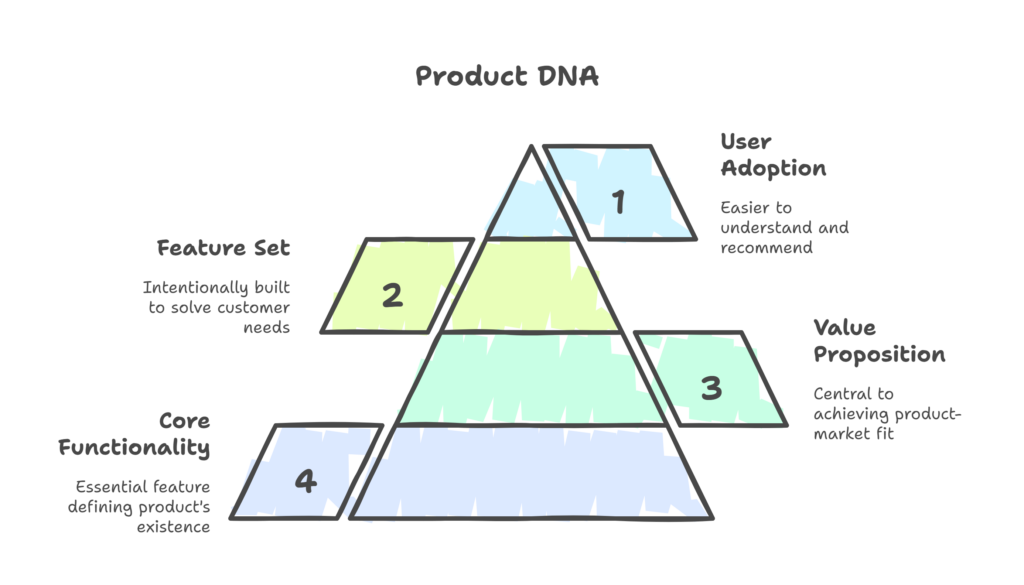
Your product’s DNA is its beating heart—the one essential feature that defines its entire reason for existing. Strip away everything else, and this is what remains.
In the Lean Product Process, this is called your Value Proposition. It sits at the center of Product-Market Fit. From there, your feature set should be built intentionally—focused on solving specific, real customer needs.
Ask yourself:
- If you could build only one feature of your product to ship, what would it be?
- Could you explain its value in under 20 seconds to a stranger?
- Can the core functionality be built in 1-6 hours (not weeks)?
Why This Matters: The Unfair Advantage of Singular Focus
The world’s greatest products don’t start out trying to do everything—they start by doing one thing incredibly well.
That might feel counterintuitive, especially in a world where “more features” often looks like “more value.” But if you look back at the most iconic products in history, there’s a clear pattern:
The “One Pain” Principle
Users pick things up faster when the purpose is obvious and focused. Give them too many options up front, and they’ll hesitate. That’s Hick’s Law in action: more choices = slower decisions.
When a product does one thing well, it’s easier to understand, use, and recommend. That’s also why word-of-mouth spreads in simple sentences.
The best products surgically attack a single, specific frustration so precisely that users feel understood.
Example:
Linktree (2016) – The Power of One Link
Core DNA: A single, simple link to rule them all.
MVP Approach:
- Solved one glaring pain point: Instagram’s “one link in bio” limitation
- Launched with just:
- A URL shortener
- Basic profile linking
- Zero logins (early users could edit via URL)
Ignored (Initially):
- Custom domains
- Analytics dashboards
- Branded designs
- E-commerce integrations
Why It Worked:
- Instant Utility
- Users grasped the value in seconds (“Oh, I need this!”)
- No onboarding required—just paste and go
- Built for Constraints
- Leaned into Instagram’s limitation instead of fighting it
- Became the unofficial workaround
- Virality by Design
- Every user became a billboard (“Check my Linktree!”)
- Organic growth through creator ecosystems
2. Product Proof – Ensuring Commercial Success
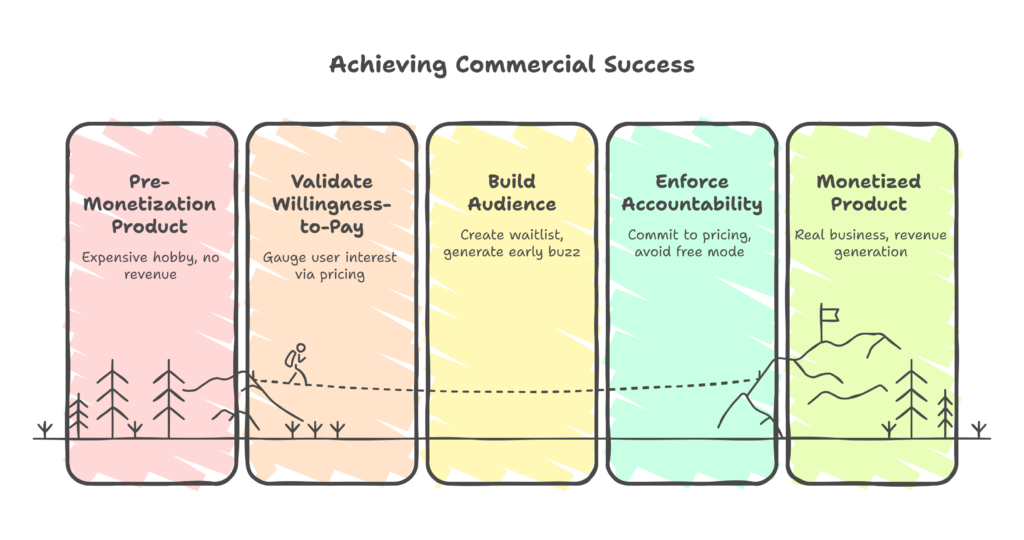
Let’s be brutally honest: your product isn’t a real business until money changes hands.
“If you’re not charging, you’re not learning.”
—Jason Lemkin, SaaStr
You could craft the most elegant solution to a genuine pain point—engineered to perfection, frictionless in its execution—but without monetization, you’re not building a company. You’re fueling an expensive hobby.
Your MVP must prove two things:
- That customers will actually pay for your solution
- That your pricing aligns with both the value you deliver and what your market can bear
The Viability Test
- Is your value metric (what you charge for) tied to what users truly care about?
- Are users reaching for their wallets, or just giving you polite gestures?
- Does your pricing model scale with both your costs and your customers’ success?
Example:
Buffer (2010) – The Ultimate Smoke Test
Core Proof: Validated that users would pay before writing a single line of code.
MVP Approach:
- Launched a fake product—just a landing page with:
- Clear value prop (“Schedule your tweets in advance”)
- Pricing tiers (including a $5/month option)
- A “Plans & Pricing” CTA (that led to a waitlist, not a real product)
Ignored (Initially):
- Analytics
- Team features
- Even basic functionality (the MVP literally didn’t exist yet)
Why It Worked:
- Proved willingness-to-pay
- Users clicked pricing buttons which signaled purchasing intent
- No hypothetical surveys. Just real user behavior to show demand.
- Built an audience
- Waitlist = captive beta testers
- Early Twitter buzz created organic demand
- Forced founder accountability
- Public pricing meant no retreat into “free mode”
3. Product Virality – Making Your Product Spread
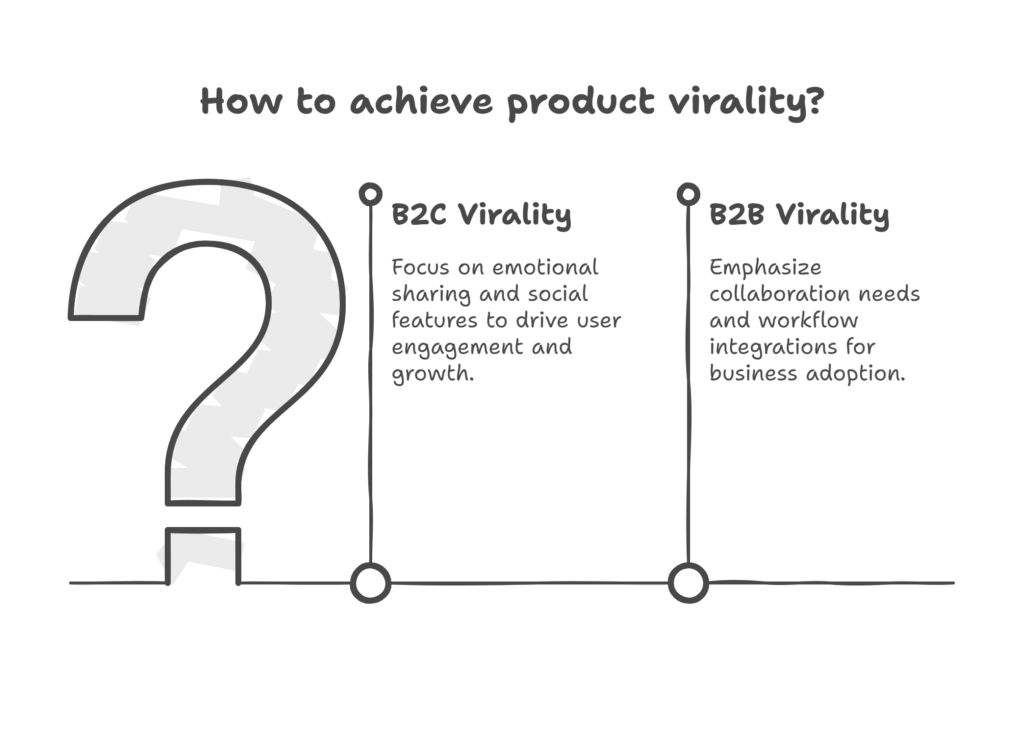
That magical moment when a product explodes—when suddenly everyone’s using it, sharing it, inviting friends—isn’t luck. It’s engineered. And when it happens, growth stops being a grind and starts working for you.
Your users become your best salespeople. Your product becomes a conversation. That’s the power of virality—not just growth, but self-sustaining growth.
B2C vs. B2B Virality: Key Differences
| B2C (e.g., TikTok, WhatsApp) | B2B (e.g., Slack, Zoom) |
|---|---|
| Built for emotional sharing (FOMO, status) | Built for collaboration needs |
| Growth loops = social features (shares, likes, tags) | Growth loops = workflow integrations |
| K-factor >1.2 ideal | Multiple invites per function, broad adoption |
| Examples: Referral bonuses, Profiles Statuses | Examples: Team seats, Product Reviews |
Example: Calendly (2013) – The Silent Salesman
Core Virality: “You can’t schedule alone.”
Built-In Spread:
- Every meeting invite showed “Powered by Calendly”
- Recipients had to sign up to propose new times
- Free plan naturally pushed teams to upgrade
Ignored (Initially):
- Analytics
- Custom branding
- Even timezone detection
Why It Worked:
- Passive Exposure:
- Each meeting sent was a free ad
- Collaboration Requirement:
- To coordinate, both sides needed accounts
- Frictionless Conversion:
- Signup took <30 seconds from a scheduling link
4. Product Trust : Building Confidence
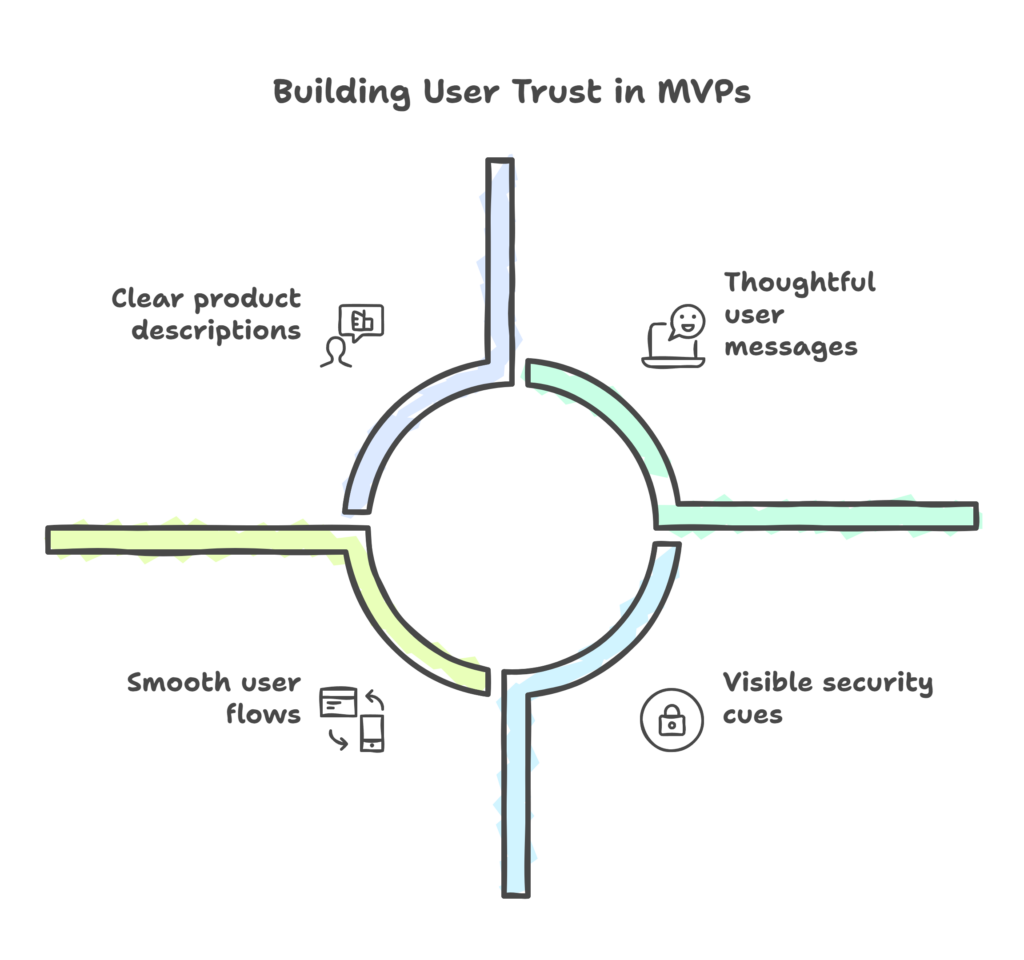
If you want people to use your MVP, you need trust, you’ve got to think beyond features. Trust is psychological. It’s what users feel after a series of consistent, positive interactions with your product. That trust gets stronger when your MVP feels credible, easy to use, and secure.
Let’s break it down a bit:
- Cognitive trust: This comes from users believing your product does what it says. It’s about meeting expectations and delivering a smooth, reliable experience.
- Emotional trust: Users feel connected when your product is thoughtful—helpful messages, smooth flows, and no surprises.
- Credibility and authority: Do you come across like you know what you’re doing? Clear copy, decent design, and even tiny touches like custom error messages.
- Security and transparency: Users want to know their data’s safe and that you’re being upfront. Simple privacy messages and visible security cues help a lot here.
The Trust Thermometer
Measure where you’re leaking confidence:
- High signup dropoffs? → Cognitive/Authority gaps
- Low activation? → Emotional trust missing
- Support tickets about security? → Transparency needed
Example:
Revolut (2015) – Banking Without the Banks
Core Trust Hack: Made fintech feel as safe as Barclays
Built Trust Through:
- Live transaction maps (“You spent £12.50 at Pret right now“) → Cognitive
- Fraud alerts in <1s (“Did you just buy an iPhone in Dubai?”) → Emotional
- FCA license number in footer + cold storage crypto docs → Authority/Security
Ignored (Initially):
- Fancy card designs
- Investment products
- Even joint accounts
Why It Worked:
- Turned skepticism (“A startup handling my money?!”) into credibility
- Used real-time data as proof of reliability
5. Product Education – Supporting Your Users
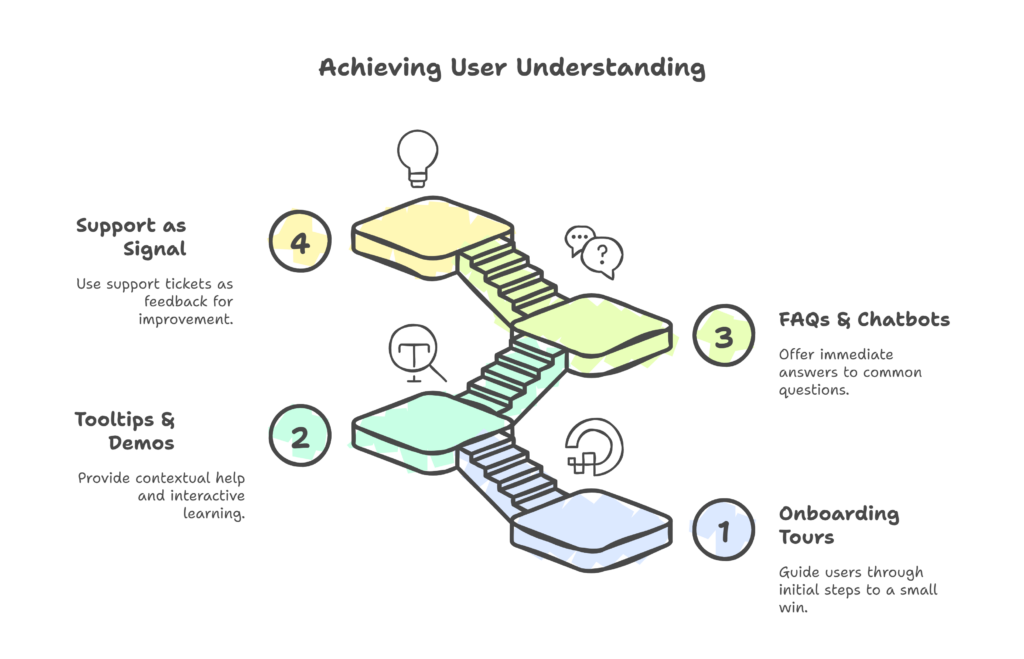
Ever wonder why users sign up, poke around a bit, then vanish? That’s churn—and most of the time, it comes down to one thing: if people don’t get your product, they won’t stick around.
Product education isn’t a nice extra. It’s the connection between what you’ve built and the user actually understanding the value. If your product feels confusing or makes a simple task feel harder than it should, users will leave. Quickly.
Clear, thoughtful onboarding and guidance help users hit that “aha” moment quicker—the point where they see, okay, this actually solves my problem. That’s when they stick.
This ties into cognitive fluency: the smoother the initial experience, the stronger the trust.
Here’s how to help users get it without overwhelming them:
- Onboarding tours: Keep it tight. 3–5 steps, max. Block out the noise and guide them to the first small win.
- Tooltips & demos: Add help where it’s needed. Hover text, short videos, or better yet—let users learn by doing with interactive walkthroughs.
- FAQs & chatbots: Answer the obvious stuff upfront. A clean FAQ or simple chatbot can save users (and your team) a lot of pain.
- Support = signal: Every support ticket is feedback. Look for patterns. Confusion is telling you exactly where to improve.
Example: Notion (2016) – Learning by Doing
Core Education Hack: Made complexity feel simple
How They Nailed It:
- Interactive Onboarding:
- New users got a pre-built personal workspace (templates for tasks, notes, docs)
- “Try editing this page” prompts instead of tours
- Contextual Learning:
- Typing “/” summoned a live menu of commands (learning while creating)
- Empty states showed actionable examples (“Click here to add a subpage”)
- Community as Curriculum:
- Public template gallery let users “remix” others’ work
- “Notion Pros” program turned power users into teachers
Ignored (Initially):
- Video tutorials
- Formal certification
- Even a help center (relied on community forums first)
Why It Worked:
- Turned using the product into learning the product
- Made every blank page feel less intimidating
The Takeaway
Building a successful product isn’t about stacking features—it’s about relentless focus.
Ask yourself:
- Is my core functionality razor-sharp?
- Would users pay for this today?
- Does using my product naturally encourage sharing?
- Do users feel safe and informed?
- Can a newcomer succeed without a manual?
Miss one pillar, and growth becomes an uphill battle. Nail all five, and you’re not just building a product—you’re building a movement.
Reading Materials:
- “The Lean Startup” – Eric Ries
- “Inspired: How to Create Products Customers Love” – Marty Cagan
- “Traction: How Any Startup Can Achieve Explosive Customer Growth” – Gabriel Weinberg & Justin Mares
- “The Hard Thing About Hard Things” – Ben Horowitz